

Handlebar reach is the distance between the saddle and the handlebar. Too long, and it forces you to straighten your arms and stretch your back. Too short, and it cramps your torso and brings your knees close to your elbows. The right setting can be read from a simple angle: the arm opening.
In short
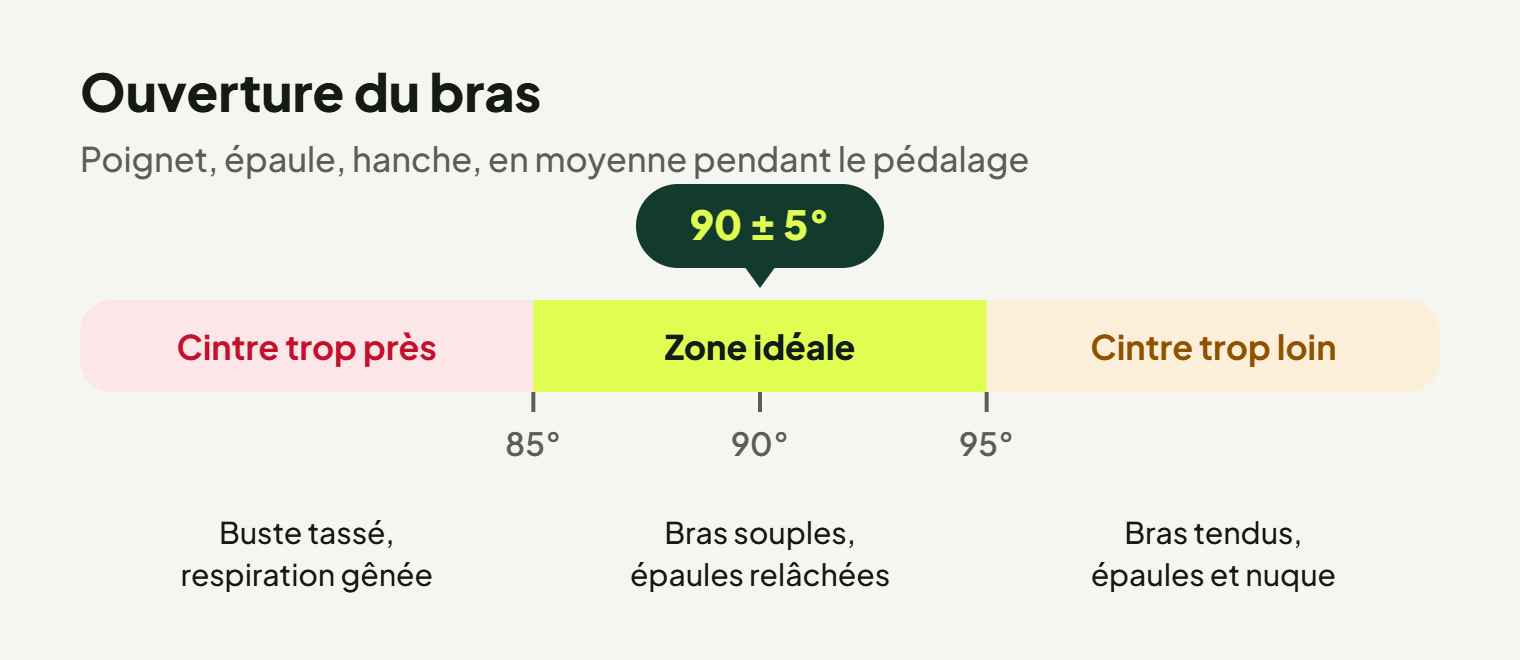
- Benchmark used in Posturise results: an arm opening (wrist, shoulder, hip) of around 90 ± 5°, on average.
- Below 85°, the handlebar is probably too close; above 95°, too far.
- Reach is mainly corrected with the stem length.
- Set the saddle first, then the handlebar height, then the reach.
Contents
What arm opening measures
Two lines are drawn: one from the wrist to the shoulder, the other from the shoulder to the hip. The angle between them is the arm opening. While you pedal with your hands on the handlebar, it moves slightly: so its average value over several revolutions is used.
| Arm opening | Reading | What to adjust |
|---|---|---|
| Less than 85° | Handlebar too close | Longer stem |
| 85 to 95° | Ideal range (90 ± 5°) | Change nothing |
| More than 95° | Handlebar too far | Shorter stem |
Signs of a poorly placed handlebar
Handlebar too far
- Straight arms, locked elbows.
- Tense shoulders and trapezius muscles, stiff neck.
- Numb hands, because vibration goes straight into the wrists.
- An urge to shuffle forward onto the nose of the saddle.
Handlebar too close
- Folded torso, restricted breathing.
- Knees brushing the elbows when out of the saddle or at the top of the pedal stroke.
- Feeling of “sitting on” the bike rather than stretched out.
Before touching the handlebar
Arm opening also depends on saddle position. A saddle too far forward brings the handlebar closer; too far back, it moves it away. So follow this order:
- Saddle height : maximum knee angle of around 141 ± 5°.
- Saddle setback and tilt.
- Handlebar height : back inclination of around 45 ± 5°. See Handlebar height: using back inclination as a guide.
- Handlebar reach, last.
Never move the saddle back or forward to correct handlebar reach: you would throw off your leg position.
Correcting the reach
Changing the stem length
This is the main solution. Stems come in 10 mm increments. Changing by one increment already makes a noticeable difference to your position. A shorter stem brings the handlebar closer; a longer one moves it away.
Adjusting the handlebar and hoods
On a drop handlebar, hoods that are raised or moved forward lengthen the position with your hands on the hoods. A short-reach handlebar (distance between the stem and the hoods) brings your hands closer without changing the stem.
If the stem isn’t enough
A very short or very long stem changes how the bike handles in corners. If the correction needed is large, frame size may be the problem: see Frame size: choosing well before you buy a bike.
One change at a time
Change the stem, do a few rides, then measure again. If you change height and reach at the same time, you won’t know which one made the difference.
Measuring with Posturise
Film 5 to 10 pedal revolutions, side-on, whole body in the frame. The Posturise AI observes in particular the movements of your shoulders, pelvis and arms, and advises you on saddle height and the handlebar. You can compare your sessions before and after changing the stem.
Frequently asked questions
Does a short stem make the bike twitchy?
A shorter stem makes the steering a little quicker. For a change of 10 or 20 mm, the difference is generally moderate.
Does the benchmark apply with hands in the drops?
The measurement is taken in your usual position, most often with hands on the tops or the hoods. In the drops, the angle naturally changes.
My neck hurts, is it the handlebar reach?
A handlebar that is too far away is a common cause, as is one that is too low. Read Neck pain when cycling: causes and solutions.