

The handlebar sets the inclination of your torso. Too low, and it forces your back to round and your neck to lift to look at the road. Too high, and it presses your weight onto the saddle and exposes you to the wind. The right setting can be read from an angle: the back inclination. Here is how to measure it, then raise or lower the handlebar without getting it wrong.
In short
- Benchmark used in Posturise results: a back inclination of around 45 ± 5°, on average.
- Below 40°, the handlebar is probably too low for you; above 50°, too high.
- Height is adjusted with the spacers under the stem, or by changing the stem angle.
- Check your saddle height first: it also changes the gap to the handlebar.
Contents
What back inclination measures
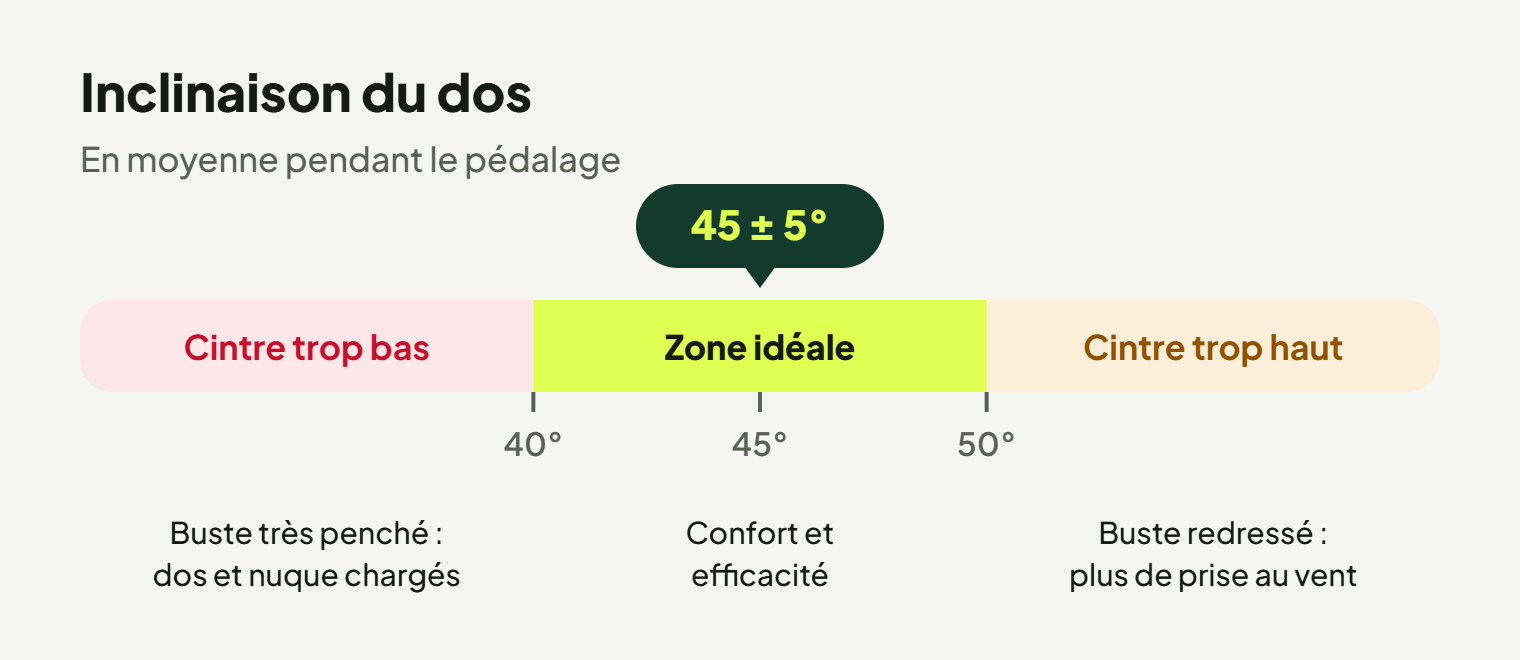
Back inclination is the angle between your torso and the horizontal while you pedal, hands on the handlebar. The lower the handlebar relative to the saddle, the smaller this angle and the more you lean forward.
| Back inclination | Reading | What to adjust |
|---|---|---|
| Less than 40° | Very low position for your flexibility | Raise the handlebar |
| 40 to 50° | Ideal range (45 ± 5°) | Change nothing |
| More than 50° | Very upright position | Lower the handlebar a little if you are after efficiency |
It is an average value: your torso moves slightly with each pedal stroke. That is why it is measured on a video rather than a photo.
Before touching the handlebar
The height difference between the saddle and the handlebar depends on both. If your saddle is too high, the handlebar will seem too low, and vice versa. So check your saddle height first (maximum knee angle of around 141 ± 5°), and only then the handlebar height.
Three ways to change the height
1. Moving the spacers
This is the simplest solution. Spacers are the rings placed below and above the stem, on the fork steerer. Moving one from above to below raises the handlebar; the opposite lowers it.
- Loosen the stem bolts (on the side) then the top cap.
- Remove the stem, move the spacers, put the stem back.
- Tighten the top cap first, just enough to remove play in the headset.
- Align the stem with the front wheel, then tighten the side bolts to the specified torque.
The number of spacers available is limited by the length of the steerer. Never remove all the spacers above the stem without checking the fork manual, especially with a carbon fork.
2. Flipping or changing the stem
A stem angled downwards can often be flipped to point upwards, which raises the handlebar. A more upright or shorter stem changes both the height and the reach of the handlebar: remember to check your arm opening again afterwards.
3. Changing the handlebar
A handlebar with less “drop” (the difference between the tops and the drops) makes the low position easier to reach, without touching the stem. It is an option to consider if you rarely ride in the drops.
Adjust gradually
- In small steps : one spacer at a time.
- One adjustment at a time : height or reach, not both at once.
- Give it time : do a few rides before judging.
- To go lower, go even more gently: your back and hamstrings need time to adapt.
Example
A measured inclination of 38° indicates a handlebar that is too low. You raise it by one spacer, ride for a week, then measure again to see whether you are within the 40 to 50° range.
Measuring with Posturise
Film 5 to 10 pedal revolutions, whole body in the frame, on a home trainer or against a wall. The AI measures your posture and advises you on saddle height and the handlebar. Your sessions can be compared over time: you can see the effect of each spacer you move straight away.
Is your back already hurting? Also read Back pain when cycling: causes, adjustments and exercises.
Frequently asked questions
Is a higher handlebar necessarily slower?
You catch a bit more wind, but a position you can hold for the whole ride is often more efficient than a very low one you can only bear for an hour.
How many spacers should I remove or add?
One at a time, then a new measurement. The exact number depends on how far you are from the ideal range and on your flexibility.
Is the benchmark the same on a mountain bike or a city bike?
The 45 ± 5° benchmark applies to a sporty position, hands on the handlebar. On a city bike, you naturally ride more upright.