

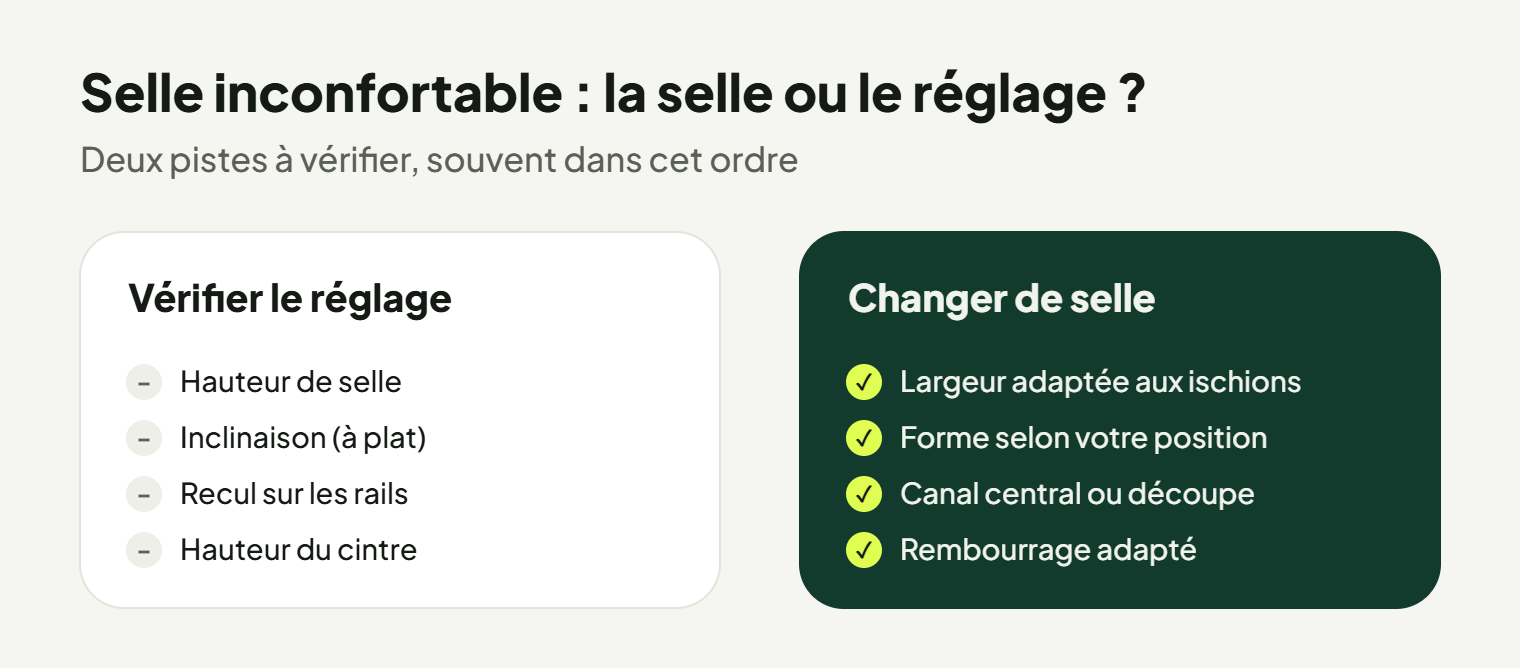
Pain in the groin, chafing, numbness, a feeling of sliding: when your saddle hurts, the first reflex is to buy another one. Yet many of these problems come from how the saddle is adjusted, not from the model. Before changing it, three checks are essential.
In short
- Check, in this order: height, tilt, setback.
- A saddle that is too high makes the pelvis rock and irritates the groin.
- A level saddle, or one very slightly nose-down, suits most cyclists.
- If the discomfort persists with a good setup, it is the width or shape that needs rethinking.
Contents
What the symptoms tell you
| What you feel | Adjustment to check first |
|---|---|
| Chafing, irritation on the inner thighs | Height (too high) or saddle too wide |
| Pressure or numbness in the groin | Tilt (nose up) or height |
| Feeling of sliding forward, weight on the hands | Tilt (nose pointing too far down) |
| Pain on the pelvic bones | Saddle width (too narrow) |
| Pelvis rocking from side to side | Height (too high) |
1. Height
A saddle that is too high is the most underestimated cause of discomfort. To reach the pedal at the bottom, the pelvis rocks from one side to the other, which rubs and irritates with every revolution. A saddle that is too low, on the other hand, loads the knees.
The benchmark: the maximum knee angle, measured while pedaling, ideally around 141 ± 5°. The step-by-step guide is in Saddle height: the knee angle method.
2. Tilt
Put a level (or a level app on your phone) on the saddle, from nose to back, with the bike on flat ground.
- Nose up: pressure on the perineum and numbness.
- Nose pointing too far down: you slide forward and push on the handlebar, which loads your hands.
- Level, or very slightly nose-down: the right starting point for most cyclists.
Change the tilt in very small steps: one or two degrees already change how it feels.
3. Setback
Setback is the fore-aft position of the saddle on its rails. Too far forward, it loads the knees and sends weight onto the hands; too far back, it stretches the back and tires the back of the thighs.
Classic starting benchmark: with the cranks horizontal, the front of the knee is roughly above the pedal axle. This is only a starting point, to be fine-tuned according to how it feels.
One adjustment at a time
Changing height, tilt and setback at the same time stops you knowing what worked. Correct one parameter, do a few rides, then move on to the next. Note: moving the saddle back also moves it away from the pedal; check the height again afterwards.
Your shorts matter too
Worn shorts with a flattened chamois, or underwear worn under your shorts, are common causes of irritation. Shorts in good condition, worn without underwear, and chamois cream on long rides prevent a lot of trouble.
When to change your saddle
If the saddle is properly set up and the discomfort persists after a few rides, the model probably doesn’t suit you: width unsuited to your sit bones, a shape that doesn’t match your position, no cut-out. Our guide Choosing a saddle: width, shape and sit bone support explains how to measure your sit bones and choose.
Checking your position
Posturise measures your posture from a video of 5 to 10 pedal revolutions and advises you on saddle height and the handlebar. After each adjustment, a new session lets you compare your results. The first one is free, with no card required.
When to see a doctor
Groin numbness that persists after the ride, sharp pain or urinary problems mean you should see a doctor.
Frequently asked questions
Is a more padded saddle more comfortable?
Not necessarily. On long rides, thick padding compresses and can increase pressure. Firm padding and good shorts are often more comfortable.
Should the saddle be set differently on a mountain bike?
The principles are the same, but you often ride a little more upright, which sometimes calls for a wider saddle.
How long does it take to get used to a new setting?
A few rides. If the discomfort doesn’t ease after two to three weeks, rethink the setup or the model.