

Back pain is one of the most common complaints among cyclists, particularly in the lower back. A study of professional cyclists placed the lower back among the areas most affected by overuse pain (Clarsen et al., 2010, American Journal of Sports Medicine). In amateurs, the pain often appears on long rides, or when moving from an upright bike to a more stretched-out road bike.
In short
- Your back suffers when your position demands more flexibility or core strength than you have.
- Three adjustments to check, in order: saddle height, handlebar height, handlebar reach.
- Posturise benchmarks: back inclination of around 45 ± 5°, arm opening of around 90 ± 5°.
- Pain that persists at rest or radiates into the leg needs medical advice.
Contents
Why the back suffers on a bike
On a bike, your back stays bent forward and still for hours while your legs do the work. Everything depends on your pelvis being able to tilt forward: if the backs of your thighs (the hamstrings) and your hips lack flexibility, the pelvis stays locked and it is the spine that rounds to reach the handlebar. The lower back and neck take the strain.
Conversely, a torso that is too upright is not ideal either: your weight bears down on the saddle, and shocks travel straight up the spine.
Causes linked to your set-up
A saddle that is too high
This is an often-forgotten cause. If the saddle is too high, the pelvis rocks from side to side with every revolution to reach the pedal. This rocking tires the muscles of the lower back. Benchmark: a maximum knee angle of around 141 ± 5°. See Saddle height: the knee angle method.
A handlebar that is too low
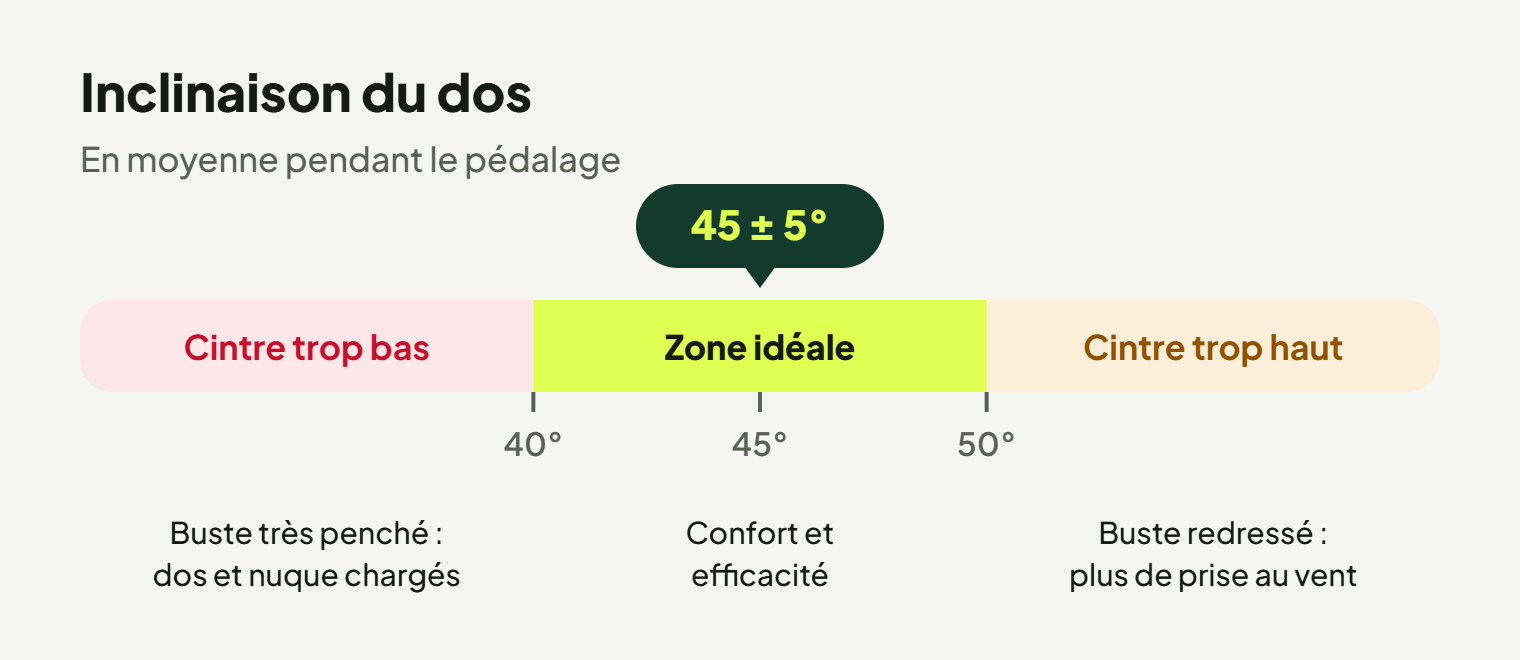
The lower the handlebar relative to the saddle, the more the torso dives. Benchmark used by Posturise: a back inclination of around 45 ± 5°, on average. Below 40°, the handlebar is probably too low for you.
A handlebar that is too far away
A handlebar that is too far away stretches the back and arms. The benchmark is arm opening (wrist, shoulder, hip), ideally around 90 ± 5°. See Handlebar reach: aim for a 90° arm opening.
Correcting, in the right order
- Saddle first : height, then setback and tilt.
- Handlebar height next, with the spacers under the stem. The step-by-step method is in Handlebar height: using back inclination as a guide.
- Handlebar reach last, with a shorter stem if needed.
- One adjustment at a time : change a single parameter, ride, then check again.
What depends on you
Even the best set-up won’t make up for everything. Three habits make a real difference:
- Flexibility : a few minutes of hamstring and hip flexor stretches after the ride help the pelvis tilt.
- Core strength : strong abdominal and back muscles support the torso over time. Two short sessions a week are enough to start.
- Gradual progress : lower your position little by little, and increase the length of your rides gradually.
While riding
Change your hand position regularly, sit up for a few seconds at the top of climbs, and remember to relax your shoulders. These micro-breaks ease your back on long rides.
Checking your position
Film 5 to 10 pedal revolutions, whole body in the frame, ideally on a home trainer or against a wall. Posturise analyzes your posture, observing your shoulders, pelvis and arms in particular, and advises you on saddle height and the handlebar. The first session is free, and you can compare your sessions after each adjustment.
When to see a doctor
See a doctor before changing your position if the pain persists at rest, radiates into the leg, comes with tingling or loss of strength, or follows a fall.
Frequently asked questions
Is a higher handlebar necessarily slower?
You catch a bit more wind, but a position you can hold for the whole ride is better than a very low one you give up after an hour.
Can back pain come from the saddle?
Yes. A saddle that is too high makes the pelvis rock with every revolution, and a saddle that is too far back stretches the back. Check the saddle before the handlebar.
Should I stop riding when my back hurts?
Reduce the duration and intensity, and sit more upright while you correct your position. If the pain is severe or persists at rest, see a doctor.
My neck hurts too, is it related?
Often, yes: a handlebar that is too low forces you to lift your head to look at the road. Read Neck pain when cycling: causes and solutions.