

Frame size is the only setting you can’t change after you buy. Saddle, handlebar, stem: everything else can be adjusted, but within the limits the frame imposes. A frame that is too big or too small forces compromises that often end in pain. Here is how to choose well.
In short
- The manufacturer’s size chart is a starting point, not a definitive answer.
- Cross-check your height and your inseam : at the same height, proportions change everything.
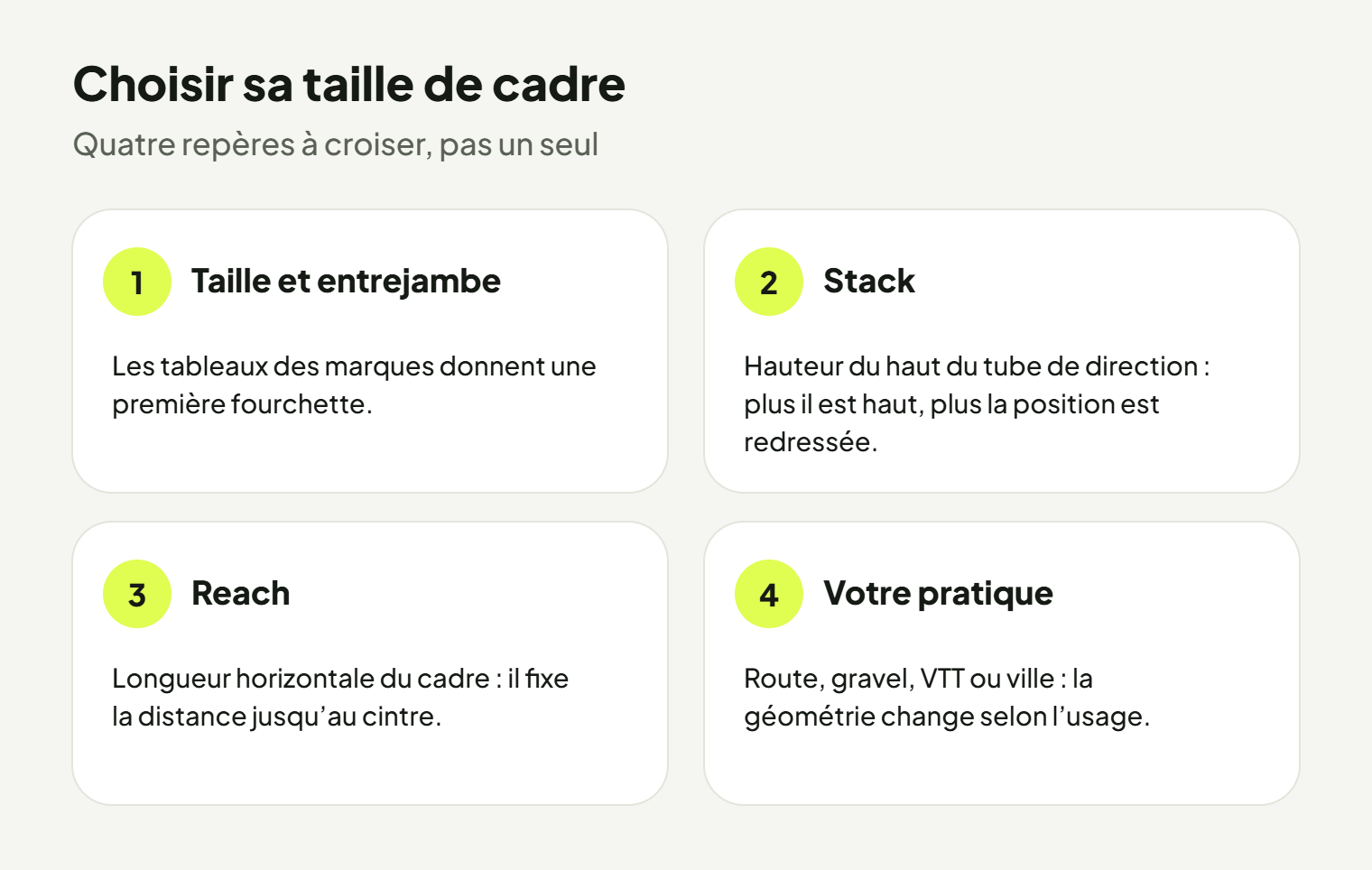
- Compare frames using stack (height) and reach (length), which are more reliable than the stated size.
- Between two sizes, the smaller one is often easier to adjust.
Contents
Why the stated size isn’t enough
“Size M”, “54”, “17 inches”: each brand measures its frames its own way, and two frames with the same stated size can have very different geometries. What’s more, two cyclists of the same height don’t have the same proportions: one has long legs and a short torso, the other the opposite.
Step 1: measure your height and inseam
- Height : barefoot, back against a wall.
- Inseam : barefoot, back against a wall, feet about fifteen centimetres apart. Slide a book up firmly into your crotch, like a saddle, and measure from the floor to the top of the book.
Check these two measurements against the manufacturer’s chart. If your height and inseam point to two different sizes, your proportions are outside the average: in that case, look at stack and reach.
Step 2: understand stack and reach
| Measurement | What it describes | What it changes for you |
|---|---|---|
| Stack | Vertical height between the bottom bracket and the top of the head tube | The bigger it is, the higher the handlebar can be: a more upright position |
| Reach | Horizontal distance between the bottom bracket and the top of the head tube | The bigger it is, the further away the handlebar: a more stretched-out position |
These two values appear in the geometry chart of most bikes. They let you compare frames from different brands, regardless of the stated size.
Step 3: take your riding into account
- Performance road bike : low stack, long reach. Requires flexibility.
- Endurance or gravel bike : higher stack, shorter reach. More forgiving for the back and neck.
- City or touring bike : upright position, tall stack.
If you are a beginner, have back problems or ride for long periods, go for a taller stack: it is easier to lower the handlebar later than to raise it beyond what the frame allows.
Between two sizes
The smaller of the two is often easier to adapt: you can raise the saddle, fit a longer stem or add spacers. A frame that is too big, on the other hand, is hard to make up for: very short stem, saddle pushed all the way forward, and a position that stays stretched out.
Try before you buy
A test ride, even a short one, tells you more than a chart. Check that you can put your feet on the ground when stopped, that the handlebar doesn’t feel too far away, and that you can reach the brakes without straightening your arms.
After you buy: adjust, then check
Once you have chosen the bike, the frame size sets the adjustment range, and the saddle and handlebar do the rest. The three benchmarks used by Posturise:
- Saddle height : maximum knee angle of around 141 ± 5°.
- Handlebar reach : arm opening of around 90 ± 5°.
- Handlebar height : back inclination of around 45 ± 5°.
Film 5 to 10 pedal revolutions on a home trainer or against a wall: the AI analyzes your posture and advises you on saddle height and the handlebar. Some partner shops even offer a first analysis after you buy a bike.
Frequently asked questions
Can a frame that is too big be made up for with adjustments?
Partly: a shorter stem and a higher handlebar help, but at the cost of quicker steering and a position that is sometimes poorly balanced. It is better to choose well from the start.
Does wheel size change anything?
It changes the height of the bike and how it handles, but not the position benchmarks: saddle height and handlebar position are set in the same way.
Can I buy a second-hand bike without knowing its geometry?
Look up the model and year: the geometry chart is often available online. Otherwise, take a test ride and measure your position after adjusting it.