

With an electric bike (e-bike), you pedal less hard, so your position matters less? It is a widespread idea, and it is wrong. The assistance reduces the effort, but it changes neither the movement of the knee, nor the way your weight rests on the saddle and your hands. And since people often ride further and more often on an e-bike, a poor position has more opportunities to make itself felt.
In short
- The leg movement is the same as on a conventional bike: saddle height matters just as much.
- E-bikes are often set up “on delivery” and never looked at again, with a saddle that is too low.
- The weight on your hands and back still depends on the handlebar.
- People often ride for longer on an e-bike: small flaws end up taking their toll.
Contents
What doesn’t change with assistance
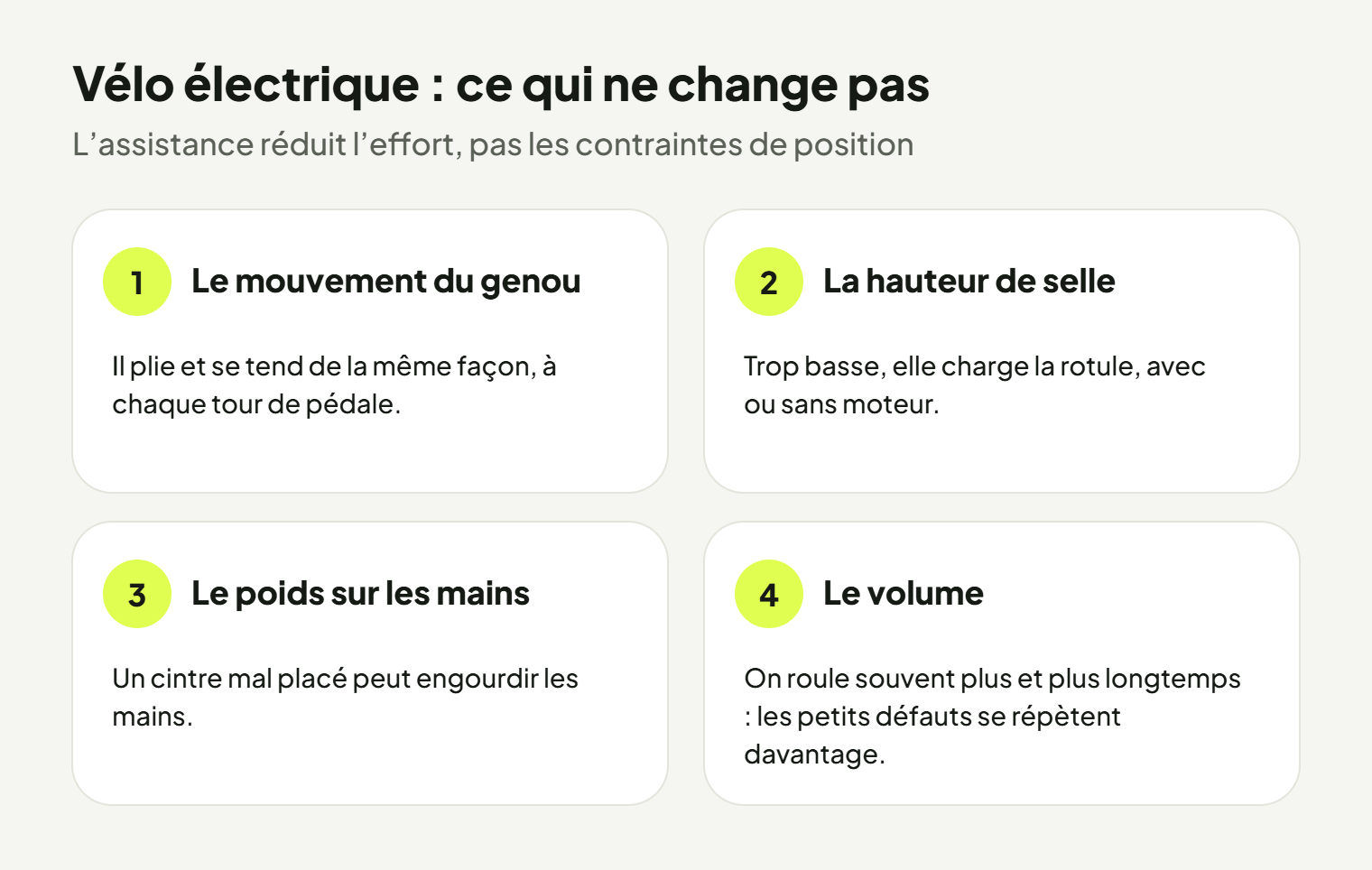
- Knee movement : the leg bends and straightens in the same way, thousands of times per ride.
- Saddle height : the benchmark is still a maximum knee angle of around 141 ± 5°.
- Weight on the hands : a handlebar that is too far away or too low loads the wrists, assistance or not.
- Volume : the assistance makes you want to ride more, and more often.
The most common mistake: a saddle that is too low
On an e-bike, many cyclists lower the saddle so they can put their feet down easily when stopped, especially in town. The result: the knee stays very bent at the bottom of the pedal stroke and the kneecap is overloaded. With the assistance, the pain takes longer to appear, but it gets there in the end.
Good practice: a saddle set for pedalling, and getting off the saddle when you stop, one foot on the ground, rather than staying seated. The step-by-step guide is in Saddle height: the knee angle method.
Other adjustments to check
Handlebar position
Urban e-bikes often have an upright position, which eases the back and neck but concentrates weight on the saddle. Sporty e-bikes (road, gravel, MTB) keep a more forward-leaning position: the back inclination (around 45 ± 5°) and arm opening (around 90 ± 5°) benchmarks apply just as on a conventional bike.
The saddle itself
In an upright position, the pelvis is straight and the contact with the saddle is wider. A narrow road saddle can then become uncomfortable. See Choosing a saddle: width, shape and sit bone support.
Cadence
The assistance lets you spin smoothly, at a higher cadence. Make the most of it: smooth pedalling is far kinder to your knees than pushing a big gear.
Filming an e-bike for the analysis
The principle is the same as with a conventional bike: film 5 to 10 pedal revolutions, side-on, whole body in the frame, ideally on a home trainer or against a wall. Detailed instructions are in Home trainer or wall: filming yourself for your analysis. Check that your home trainer is compatible with an e-bike before mounting the bike on it.
Posturise analyses your posture and advises you on saddle height and the handlebar. The first session is free, with no card required.
Frequently asked questions
Should an e-bike be set up differently from a conventional bike?
The benchmarks are the same: knee angle, arm opening, back inclination. Only the overall position (more or less upright) depends on the type of bike.
My knees hurt on my e-bike even though I’m not pushing hard, why?
Most often, the saddle is too low. The low effort masks the problem at first, but volume eventually reveals it.
Is a bike fit useful for an electric city bike?
Yes, especially if you use it every day. A correct saddle setting is often enough to avoid knee pain. See also our bike fitting guide.