

When your knee hurts on the bike, the temptation is to change everything at once: saddle, cleats, pedals. Bad idea, because you no longer know what worked. The exact location of the pain is your best clue. This sheet helps you link the discomfort to the adjustment to check first.
In short
- Front of the knee: saddle often too low or too far forward.
- Back of the knee: saddle often too high or too far back.
- Inside or outside: look first at the cleats and foot alignment.
- Only one adjustment at a time, then measure again.
Contents
Step 1: locate the pain
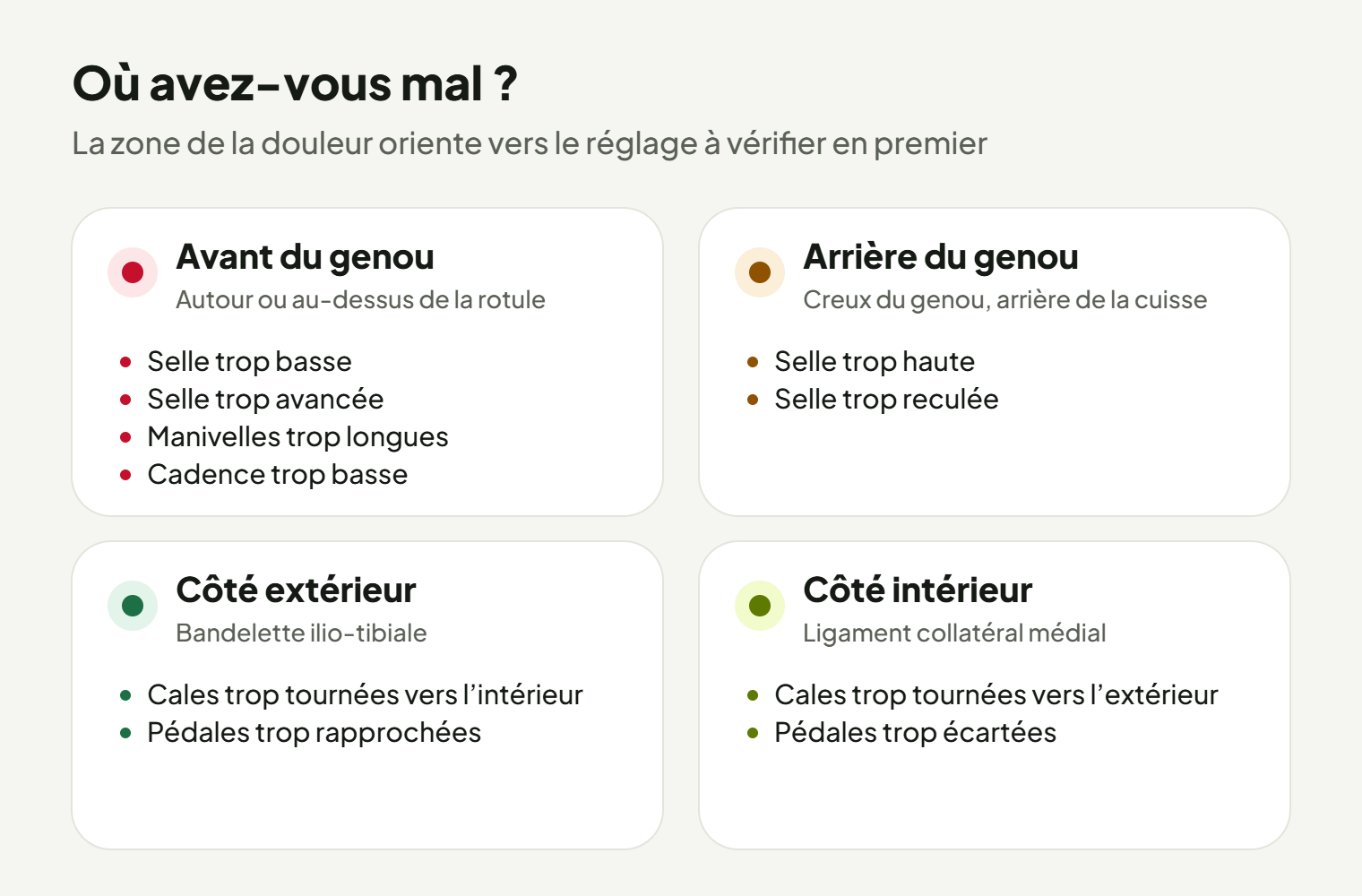
Before touching the bike, note exactly where it hurts, at what point in the ride the pain appears, and whether it goes away at rest. These three pieces of information guide everything else.
Step 2: link the area to the adjustment
| Where it hurts | Adjustment to check first | What is often seen |
|---|---|---|
| Front, around the kneecap | Saddle height (too low) | Knee very bent at the bottom of the pedal stroke, thighs burning quickly |
| Front, when climbing or pushing hard | Saddle setback (too far forward) | Kneecap ahead of the pedal axle with the crank horizontal |
| Behind the knee | Saddle height (too high) | Leg overextended, rocking pelvis, toes pointing down |
| Outside | Cleats and distance between the feet | Knee drifting outwards or foot locked at a forced angle |
| Inside | Cleats and knee alignment | Knee dropping in toward the frame with each revolution |
This table gives the most common cause, not a diagnosis. Several causes can add up.
Step 3: check with a measurement
For saddle height, the benchmark is the maximum knee angle, measured while pedaling: the ideal range is around 141 ± 5°. Below 136°, the saddle is probably too low; above 146°, too high. The full method is detailed in Saddle height: the knee angle method.
With Posturise, you film 5 to 10 pedal revolutions, whole body in the frame. The AI observes in particular the movements of your feet, knees and pelvis, and gives your knee angle and foot position, with advice on saddle height and the handlebar.
Cleats, however, are not among the adjustments Posturise suggests. For pain on the side of the knee, a visit to a partner professional can be useful.
Step 4: correct, then wait
- Correct a single parameter : height, or setback, or cleats.
- In small steps : a few millimeters for the saddle, one or two degrees for the cleats.
- Ride gently for one to two weeks, without very long or very hard rides.
- Measure again and compare your sessions.
Volume matters too
A perfect setup won’t protect you from too sudden an increase in distance. Building up too quickly remains a classic cause of knee pain, with or without a position problem.
When to see a doctor
See a doctor or a physical therapist if the pain persists at rest, if the knee swells, locks or gives way, or if the discomfort doesn’t ease after the corrections. A bike adjustment does not replace medical advice.
To understand all the causes, solutions and prevention, read our guide Knee pain when cycling: causes, solutions and prevention.
Frequently asked questions
Both my knees hurt, what does that indicate?
Symmetrical pain points rather to a setting shared by both legs: saddle height or setback. Pain on one side only suggests the cleats or an asymmetry in the body.
How long before I feel an improvement?
Allow a few rides. If nothing changes after two to three weeks, the setting you corrected was probably not the right one, or the cause is not mechanical.
Should I stop cycling when my knee hurts?
Reduce intensity and duration, and avoid grinding up climbs. If the pain is sharp or persists at rest, stop and see a doctor.