

The knee is the joint that works hardest on a bike: it bends and straightens several thousand times an hour. It is also one of the most frequently painful areas in cyclists, amateur and professional alike (Clarsen et al., 2010, American Journal of Sports Medicine ; Wilber et al., 1995, International Journal of Sports Medicine). The good news: most of these pains have a mechanical cause that an adjustment can correct.
In short
- Where it hurts points to the cause: front, back, outside or inside of the knee.
- The most common cause is saddle height, too low or too high.
- Benchmark: a maximum knee angle of around 141 ± 5°, measured while pedaling.
- Training volume matters too: building up too quickly is enough to trigger pain.
- Pain at rest, swelling or locking: see a doctor.
Contents
Why the knee suffers on a bike
With every pedal revolution, the knee bends then straightens, guided by the position of the foot on the pedal and of the pelvis on the saddle. If either is poorly placed, the knee works through a range or an axis that does not suit it. On its own, this small flaw doesn’t hurt. Repeated thousands of times, it ends up irritating the tendons or cartilage.
That is why pain often appears after a specific length of ride, and increases with volume.
Where does it hurt?
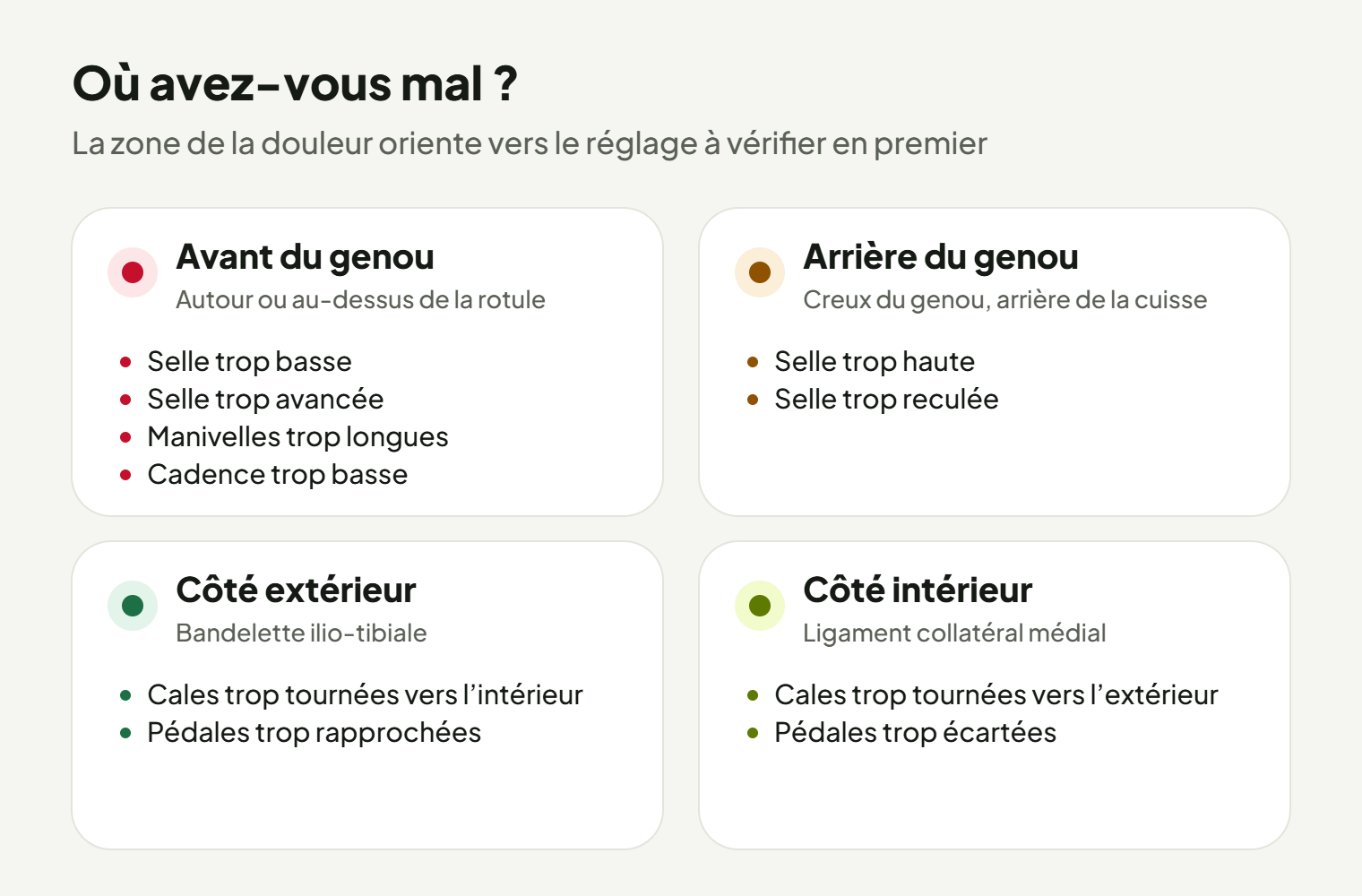
Pain at the front of the knee
This is the most common. It is felt around or above the kneecap, and gets worse when climbing or pushing hard.
- Saddle too low : the knee stays very bent and the kneecap is compressed.
- Saddle too far forward : the knee goes in front of the pedal and the pressure on the kneecap increases.
- Gears too big : pushing hard at a low cadence overloads the front of the knee.
Pain at the back of the knee
- Saddle too high : the leg overextends at the bottom of the pedal stroke and stretches the back of the knee.
- Saddle too far back : the leg reaches further for the pedal, with the same effect.
Pain on the outside
- Poorly aligned cleats : a foot locked at an angle that is not natural for it makes the knee work under torsion.
- Distance between the feet unsuited to the width of your pelvis.
Pain on the inside
- Knee dropping in toward the frame with each revolution, often linked to cleat position or how the foot sits in the shoe.
The practical sheet Knee pain when cycling: matching the discomfort to the right adjustment sums up these links in a table.
Saddle height, the number one cause
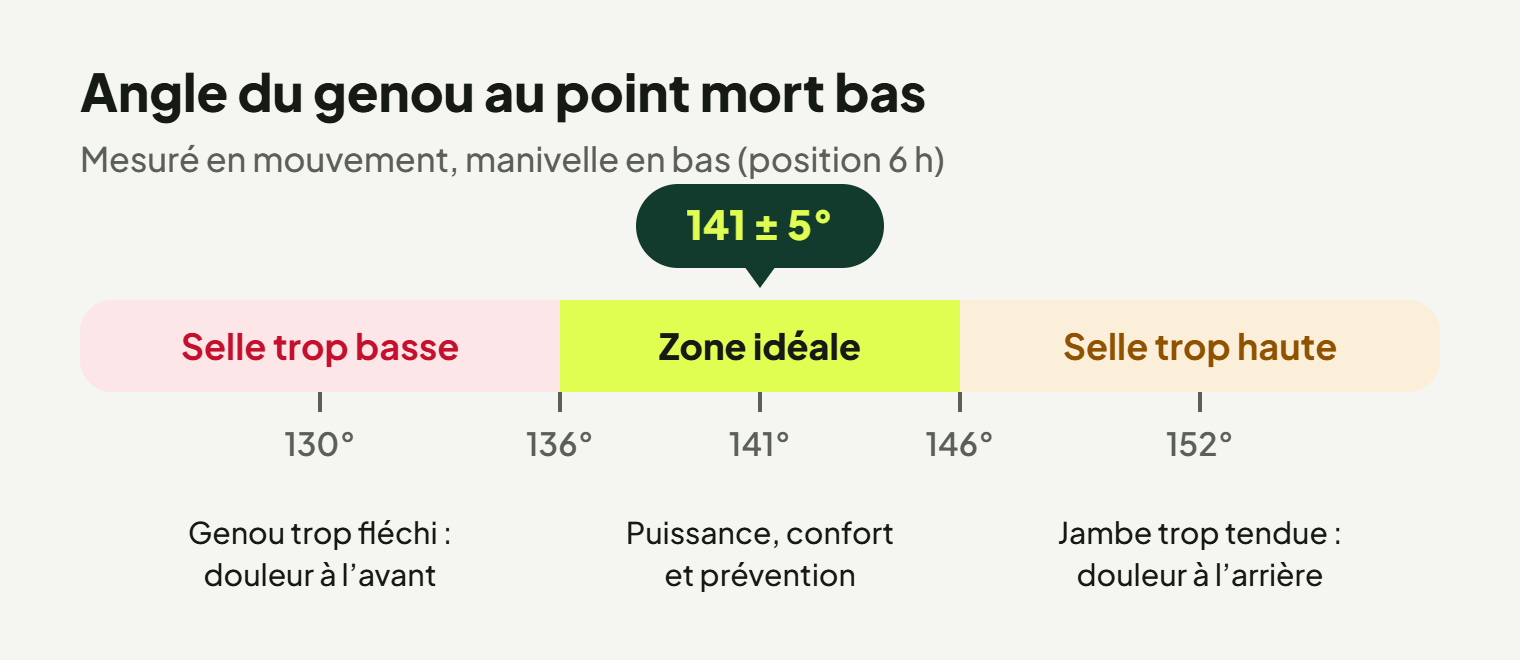
When looking for the cause of knee pain, you almost always start with saddle height. The most reliable benchmark is the maximum knee angle, measured while pedaling:
| Maximum knee angle | Reading | Typical pain |
|---|---|---|
| Less than 136° | Saddle too low | Front of the knee |
| 136 to 146° | Ideal range (141 ± 5°) | — |
| More than 146° | Saddle too high | Back of the knee |
These values are measured in motion: a setting made while stationary does not guarantee the right knee flexion when pedaling (Ferrer-Roca et al., 2012, Journal of Strength and Conditioning Research). All the details are in our complete saddle height guide.
Other causes to check
- Saddle setback : it shares the work between the front and the back of the thigh.
- Cleats : rotation, fore-aft position and distance between the feet. Pain on the side of the knee often comes from here.
- Crank length : cranks that are too long for your height increase knee flexion at the top of the pedal stroke.
- Equipment that has changed : new shoes, insoles or pedals move the foot by a few millimeters.
- Training volume : a sudden increase in distance or climbing, especially when getting back into riding.
Correcting without making it worse
- Reduce the load : shorter rides, on the flat, spinning a small gear.
- Start with saddle height, then setback, then cleats.
- One adjustment at a time, in small steps of a few millimeters or one or two degrees.
- Give it time : one to two weeks before judging.
- Measure again and compare with the previous measurement.
What Posturise measures, and what it doesn’t adjust
Posturise measures the knee angle and foot position from a video, and advises you on saddle height and the handlebar. Cleat adjustment is outside its scope: for pain on the side of the knee, a visit to a partner professional can complement the analysis.
Preventing pain
- Check your position after every change of equipment and every time you get back into riding.
- Increase gradually the length and climbing of your rides.
- Spin smoothly rather than pushing hard, especially uphill.
- Cover your knees in cold weather: knee warmers or tights.
- Strengthen your thighs and hips off the bike: strong stabilizing muscles guide the knee better.
When to see a doctor
See a doctor or a physical therapist if:
- the pain persists at rest or at night;
- the knee swells, locks or gives way;
- the pain follows a fall;
- it does not ease after two to three weeks of corrections.
A bike adjustment does not replace medical advice. Conversely, health professionals can use a posture analysis to assess their patients’ pedaling technique.
Checking your position
Film 5 to 10 pedal revolutions, side-on, whole body in the frame, on a home trainer or against a wall. The Posturise AI observes the movements of your feet, knees and pelvis, and tells you which way to adjust the saddle. The first session is free, with no card required, and you can compare your sessions after each adjustment.
Frequently asked questions
Why does the front of my knee hurt when cycling?
Most often, the saddle is too low or too far forward: the knee stays very bent and the kneecap is compressed. Pushing big gears makes it worse.
Why does the back of my knee hurt?
Most often, the saddle is too high or too far back: the leg overextends at the bottom of the pedal stroke.
Can I keep riding with knee pain?
By greatly reducing intensity and duration, and if the pain stays mild. If it is sharp, persists at rest or comes with swelling, stop and see a doctor.
How long does it take for the pain to go after an adjustment?
Often a few rides to a few weeks. If nothing changes after two to three weeks, the cause lies elsewhere: another adjustment, volume, or a medical problem.
Can a knee brace help?
It can bring temporary relief, but does not correct the cause. Start by checking your settings, and ask a health professional for advice.