

On a bike, your neck is working all the time: with your torso leaning forward, it has to lift your head to look at the road, for hours. A study of amateur cyclists found the neck among the most frequently painful areas (Wilber et al., 1995, International Journal of Sports Medicine). In most cases, the bike position is to blame, and a few adjustments are enough to bring relief.
In short
- The more your torso leans forward, the more your neck has to lift to look ahead.
- Adjustments to check: handlebar height (back inclination of around 45 ± 5°) and handlebar reach (arm opening of around 90 ± 5°).
- Relaxed shoulders, soft elbows and regular changes of position help a lot.
- Pain radiating into the arm or tingling: see a doctor.
Contents
Why the neck suffers
Leaning over the bike, you look at the road by lifting your head. The lower your torso, the more your neck has to arch, and the harder the muscles at the back of the neck and the trapezius work to hold up the weight of your head. On a ride of several hours, fatigue builds up: stiffness, tension, sometimes headaches.
Your shoulders play a part too: if your arms are straight and your shoulders hunched up toward your ears, your trapezius muscles stay tense for the whole ride.
Causes linked to your setup
A handlebar that is too low
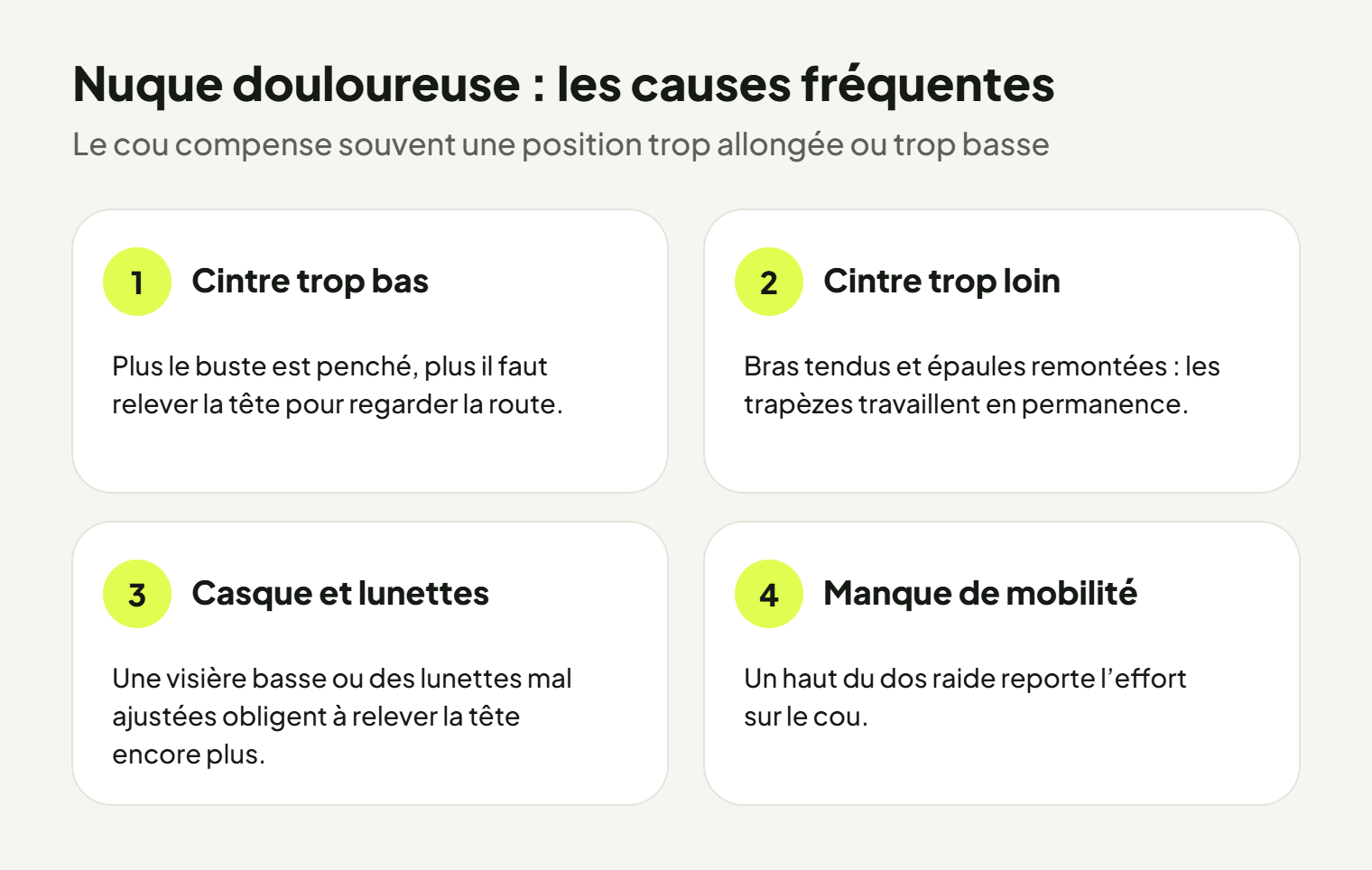
This is the most common cause. A torso leaning far forward forces you to lift your head a lot. Benchmark used by Posturise: a back inclination of around 45 ± 5°. Below 40°, the handlebar is probably too low for you. See Handlebar height: using back inclination as a guide.
A handlebar that is too far away
Straight arms, hunched shoulders, tense trapezius: a handlebar that is too far away loads the upper back and neck. Benchmark: an arm opening of around 90 ± 5°. See Handlebar reach: aim for a 90° arm opening.
A saddle that sends weight forward
A saddle pointing nose-down or too far forward makes the pelvis slide forward: your arms and shoulders hold up your torso, and your neck tenses.
Other common causes
- Helmet and glasses : a helmet that tips forward, or glasses whose frame cuts across your field of vision, force you to lift your head further.
- A backpack : it pulls on your shoulders and loads your neck. Use bike bags instead.
- Upper back stiffness : if your upper back has little mobility, your neck compensates.
Good habits while riding
- Relax your shoulders regularly, moving them away from your ears.
- Keep your elbows slightly bent.
- Change your hand position : tops to sit up, hoods, drops.
- Move your head on quiet stretches: a few slow rotations, safely.
- Look far ahead with your eyes rather than lifting your whole head.
After the ride
A few gentle neck and trapezius stretches, and upper back mobility exercises, help you recover. Take it easy.
Checking your position
With Posturise, you film 5 to 10 pedal revolutions, whole body in the frame. The AI observes in particular your shoulders, pelvis and arms, and gives you advice on saddle height and the handlebar. You can compare your sessions after each adjustment. The first one is free, with no card required.
When to see a doctor
See a doctor if the pain persists at rest, radiates into the shoulder or arm, comes with tingling or loss of strength, or follows a fall.
Frequently asked questions
Does a higher handlebar always solve the problem?
Often, but not always: if the handlebar is too far away, raising it isn’t enough. Check both height and reach.
Are neck pain and back pain linked?
Yes, they often have the same cause: a torso leaning too far forward for your flexibility. Also read Back pain when cycling: causes, adjustments and exercises.
Do triathlon aero bars tire the neck?
The very low position requires you to lift your head a lot. Work on it gradually, with short periods at first.