

A bike fit, or cycling posture analysis, means adapting the bike to your body, not the other way round. Whether you ride for fun, for performance or to get to work, a good position makes the difference between smooth pedalling and one ache after another.
Many cyclists buy a bike in “the right size” and assume that is enough. In reality, frame size is only a starting point: it is the saddle and handlebar adjustments that turn an off-the-shelf bike into a bike made for you.
In short
- A bike fit adjusts the saddle and the handlebar (and sometimes the cleats) to your body and your riding.
- It helps you ride without pain, ride more efficiently and prevent injuries.
- Two approaches: in a studio (a paid session with a fitter) or online, using video analysis.
- Three angles are enough for the main adjustments: knee 141 ± 5°, arm 90 ± 5°, back 45 ± 5°.
What is a bike fit?
It is a methodical analysis of your position on the bike. A professional, or an analysis tool, studies the relationship between your body and your bike to spot imbalances, tension and lost efficiency.
The analysis takes into account your proportions, your flexibility, your riding and your particularities (asymmetry, old injury). The result: concrete adjustments for the saddle and the handlebar and, depending on the approach, for the cleats or other parts.
Why it helps
- Riding without pain: knees, back, neck and hands are the areas most often affected in cyclists (Wilber et al., 1995, International Journal of Sports Medicine; Clarsen et al., 2010, American Journal of Sports Medicine). Many of these pains have a mechanical cause.
- Riding more efficiently: muscles working through a good range of motion waste less energy.
- Lasting longer: a comfortable position can be held for the whole ride.
The three main adjustments
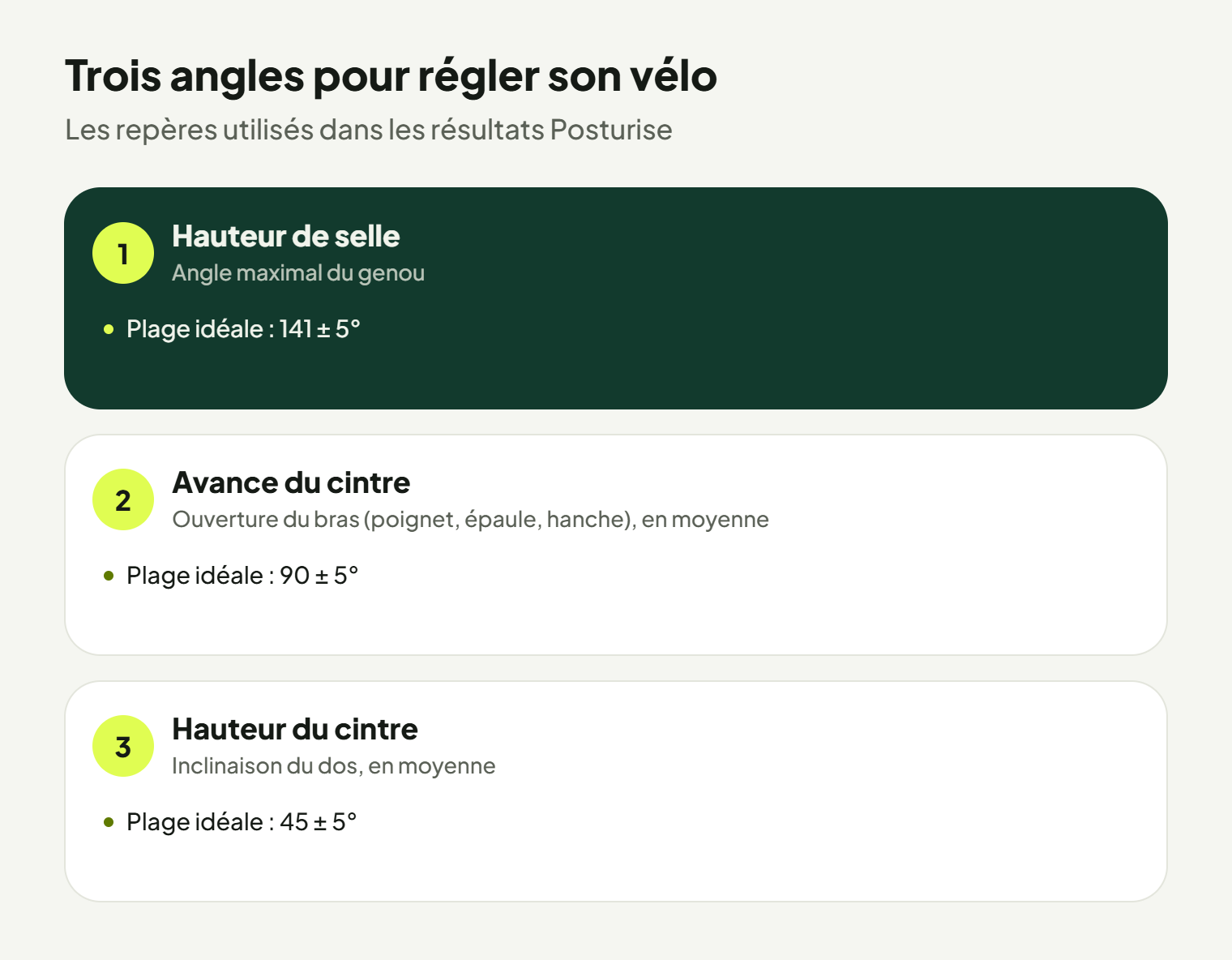
1. Saddle height
This is the most important adjustment. It sets the knee angle at the bottom of the pedal stroke: too closed (saddle too low) and it overloads the kneecap; too open (saddle too high) and it stretches the back of the leg and destabilizes the pelvis. Benchmark: 141 ± 5°, measured while pedalling. Everything you need to know is in our saddle height guide.
2. Handlebar reach
This is the distance between the saddle and the handlebar. Too far and you stretch out, loading your back, neck and hands; too close and your torso is cramped. It is mainly adjusted with the stem length. Benchmark used by Posturise: an arm opening (wrist, shoulder, hip) of around 90 ± 5°. See Handlebar reach: aim for a 90° arm opening.
3. Handlebar height
This is the height difference between the saddle and the handlebar. The lower the handlebar, the more you lean forward: it is more aerodynamic, but it requires flexibility. It is adjusted with the spacers under the stem or the stem angle. Benchmark: a back inclination of around 45 ± 5°. See Handlebar height: using back inclination as a guide.
Other parameters
- Saddle setback: shares the work between the front and the back of the thighs.
- Saddle tilt: level or very slightly nose-down.
- Saddle choice: a width suited to your sit bones. See Choosing a saddle.
- Cleats: rotation, fore-aft position, distance between the feet.
- Handlebar width and crank length.
Where are your three angles?
Film a few pedal strokes: Posturise measures your knee, arms and back, and tells you what to adjust. Your first analysis is free.
In a studio or online?
| Criterion | In a studio | Online with Posturise |
|---|---|---|
| How it works | A session with a fitter, adjustments made on the spot | You film a few pedal revolutions, the AI measures your angles |
| Price | A paid session with a fitter | First session free, no card required |
| Logistics | Appointment and travel | From home, no appointment |
| Adjustments | Saddle, handlebar, often cleats and other parts | Advice on saddle height and handlebar position |
| Follow-up | Another session to book | Several sessions, comparable over time |
| Best for | Complex cases, persistent pain, asymmetries | Main adjustments, new equipment, follow-up |
Many cyclists combine both: the online analysis for the initial adjustments and follow-up, and a visit to a studio if a problem persists. The detailed comparison is in In-studio or online bike fitting: what really changes. For in-person support, see our partner shops and professionals.
Who is it for?
Bike fitting is not just for racers:
- Beginners, who cannot yet recognize a poor position and put their aches down to a lack of practice.
- Regular cyclists, who quickly feel the effects of a poor set-up: knees, neck, hands.
- Cyclists changing equipment: bike, saddle, shoes, pedals. See also Frame size: choosing well before you buy a bike.
- E-bike riders, who often ride for longer. See E-bikes: why your position still matters.
- Health professionals (physiotherapists, osteopaths) who want to assess their patients’ pedalling technique.
How a Posturise analysis works
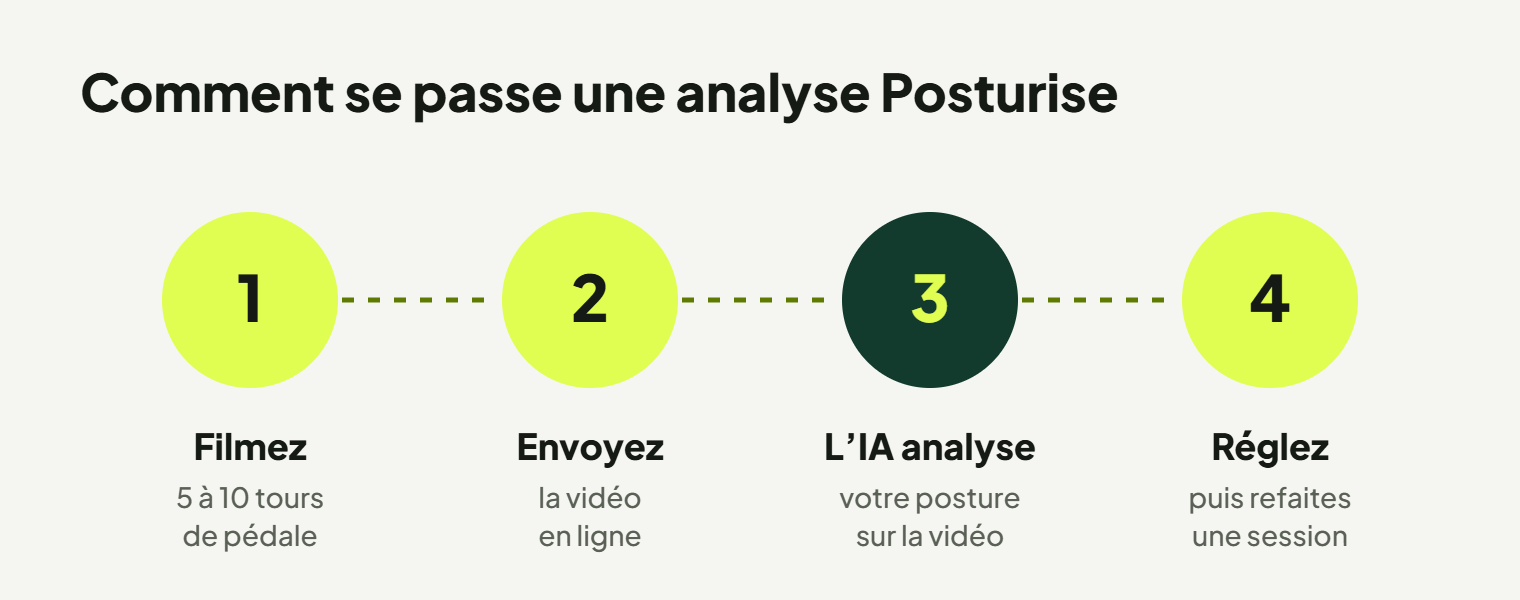
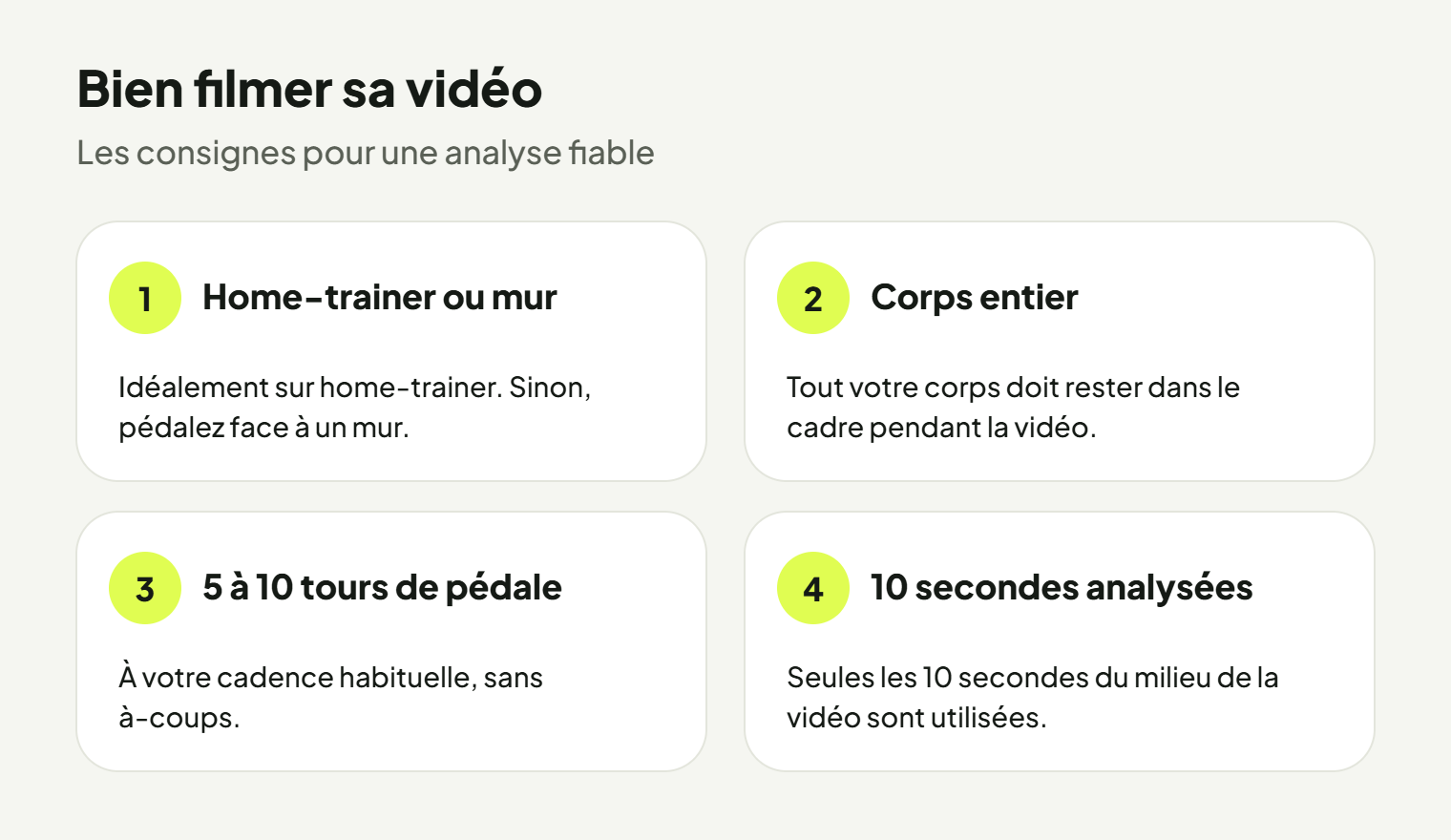
- Film 5 to 10 pedal revolutions on a home trainer or, failing that, against a wall, side-on, with your whole body in the frame.
- Send the video: the AI analyzes the central 10 seconds, observing the movements of your feet, knees, shoulders, pelvis and arms.
- Get your results: knee angle, foot position and aerodynamics, among others, with adjustment points for saddle height and the handlebar.
- Adjust, then do another session to compare your results over time.
Detailed filming instructions are in Home trainer or wall: filming yourself for your analysis, and how the measurement works is explained in How AI measures your posture, frame by frame.
Common myths
“My bike is the right size, that’s enough”
Frame size sets the possible adjustment range. With the same size, two cyclists will need different settings depending on their proportions and flexibility.
“It’s for pros”
Professionals have teams looking after their position. It is amateurs who most often ride poorly set-up bikes.
“It’s too expensive”
A traditional bike fit is a paid session with a fitter. Posturise exists to make posture analysis affordable: your first session is free. And to treat a cyclist, there is the Posturise gift card.
“I’ve been riding for 20 years, I know my position”
Your body changes: flexibility, muscles, build. A position that was right five years ago may not be any more, and the body ends up finding a position “normal” when it isn’t.
How often should you redo it?
- After a change of equipment: bike, saddle, shoes, pedals, stem.
- When pain appears.
- When your condition changes: flexibility, weight, return after an injury.
- In spring, before the season. See Getting back on the bike in spring: 6 things to check.
Frequently asked questions
How much does a cycling posture analysis cost?
In a studio, it is a paid session with a fitter. With Posturise, the first session is free, with no card required; the terms for further sessions are on the Pricing page.
Does an online analysis replace an in-studio fit?
For the main adjustments (saddle height, handlebar position) and follow-up, it is often enough. For complex cases, persistent pain or cleat adjustment, a studio remains more thorough. The two work well together.
What does Posturise measure?
Among other things, knee angle, foot position and aerodynamics, from a video of 5 to 10 pedal revolutions. The advice covers saddle height and the handlebar.
Do I need a home trainer?
It is the recommended set-up, but you can also pedal leaning against a wall. On a fixed-gear bike, Posturise suggests renting a home trainer.
Is a bike fit useful on an e-bike?
Yes: the assistance reduces the effort, not the movement of the knee. The benchmarks are the same.
Any other questions? See our FAQ.